
THE Global Problem
Our digital world trades in genetic information
As science evolves, our genetic data is increasingly being put to use. Everyone from medical institutions, researchers, to governments, security institutions, universities, are collect biological data, including sequenced DNA.
But standard practice at the moment is to gather and share the entire DNA sequences for base pair matching. This is the genetic equivalent of handing over your entire bank details and financial history every time you buy something online.
Current practice leaves both subject of the DNA and the handler of the data vulnerable to that data being stolen or lost and then potentially misused. Once your DNA sequence has been lost, it is lost for good.
The risks of this happening has never been greater thanks to growing prevalence of cyber-attacks, hacking, phishing by both state and criminal actors.
The solution to the question of how we keep our DNA and genetic data secure and private is Undisclosed DNA.
Case Study:
23 AND ME
23andMe was one of the pioneers of home DNA testing. It was a fantastic source of information about family links and genetic predispositions. Anyone with a simple saliva sample was suddenly empowered to seize on the opportunity to find a third cousin who lived overseas. Alternatively, it was a great way to seek assurance over genetic conditions.
However, the initial enthusiasm has been tempered by experience. During the firm’s sales process users were suddenly faced with the prospect that their data – and their most intimate genetic data at that – being sold on the open market to the highest bidder.
23andMe were subsequently fined £2.31 million by the Information Commissioners Office for failing to protect UK users’ genetic data.
The well- publicised financial woes of 23andMe, together with regulatory intervention and23andMe’s subsequent sale have served to illustrate how vulnerable DNA information potentially can be.
In a world of DNA rich technology and personal medicine, citizens have a right to control their DNA. As has been demonstrated by the approach of UK and international regulators.
However, there is another way. Consumers don’t have to choose between learning from their DNA or keeping it private and secure. They can instead use Undisclosed DNA’s technology to share it for limited purposes.
So, we can still get all the benefits of advances in DNA and genetic research, without the security and privacy risks that come with it. Undisclosed DNA provides the ultimate solution to this ethical dilemma of sharing DNA data.
23andMe fined £2.31 million for failing to protect UK users’ genetic data
ICO Press Release 25th June 2025
BBC News 19th May 2025
Protecting genetic privacy
Ending the wild west in genetic security
The maths are complicated but the principle and application are logical.
Read below to get an overview of how we “lock” DNA sequences to ensure access to only necessary information.

The Problem
The Base-Pair Matching Dilemma
Until now, it has been assumed that the only way to compare DNA was through base pair matching. However, this approach means anyone comparing DNA is storing and analysing the entire DNA sequence.
That means even if they only need to study on element of the DNA sequence, they are handed data that represents a person’s entire DNA code, with information about their personal characteristics, their medical history, and much more besides.
Until now, experts have assumed that Base Pair matching was the only way to do this. Undisclosed DNA changes all that.
The Solution
How Undisclosed DNA secures DNA data and guarantees its privacy
Undisclosed DNA’s unique and patented technology works differently to Base Pair matching.
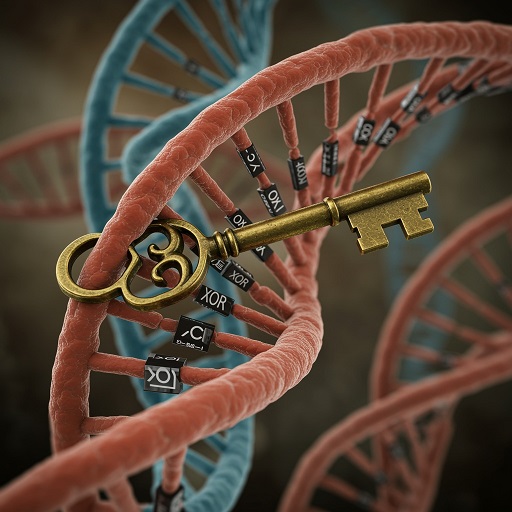
Our technology is the first of its kind that is able to store DNA in an encrypted format – with analysts only able to access the particular section of the DNA that they are authorised to use.
Undisclosed DNA uses one-way encryption which means, once applied, the DNA code we encrypt can never be unlocked – even once quantum computing becomes a reality it will remain unbreakable meaning DNA data will always be secure and private.
Our unique and patented cryptography means we can speed up searches and differentiate near matches while still preserving privacy and security.
When researchers need to access an element of the DNA, they can be given the key to see the relevant bit of genetic data, and only the relevant bit. Everything else remains private and secure.
Whether you want to embed our source code in your existing software or use our upcoming off-the-shelf solution, Undisclosed DNA has the solution to your DNA safety dilemma.
The Gordian Knot: ACCESS & SECURITY
From biology, we know what DNA is, the various chromosomes, the mitochondria, and the four base pairs that form DNA. Genetic code is not a black box. We know exactly how each snippet relates to every other snippet. The downside is that it is disastrous if someone can read your DNA code.
We use cutting-edge technology, but the underlying science has existed in the worlds of biologists and mathematicians for decades. As a result, our methods are not experimental or perpetually ‘just around the corner’.
Undisclosed DNA uses two tools, the Genetic Address™ and the private key, to satisfy both law enforcement and privacy advocates. Politicians can thread the needle by mandating the handling of genetic code in a way that protects the privacy of each person. Undisclosed DNA offers ways to accomplish this here and now so that a relevant law would be practicable.
Biological data is sovereign and private. If it can’t be protected, it must be lockable.
The genetic address
With cryptography, we have the know-how to make algorithms and formulas that tick the boxes we want. We can deploy maths that is easy in one direction but not another – i.e., not reversible – and at the same time we can speed up searches. Most significantly, we can differentiate near matches while still preserving privacy. Traditionally, cryptography has concerned itself with people who already know about each other or to conduct financial transactions or to be as unique as possible.
The Genetic Address™ brings us almost all the way there. It reduces the workload of matching millions of people’s DNA, an enormous computing burden. It is deterministic, needing only a single cell from your body to make a hash that will never change from birth to death.
This allows both the genetic owner and the owner of the data to be protected if their data is misused or captured for hostile purposes.
applications
Where can this technology be used?
Undisclosed DNA’s unique and patented DNA has applications in a wide range of fields including:
Medical Research
Undisclosed DNA is able to store DNA in an encrypted format – with analysts only able to access the particular section of the DNA that they need. This enables fully anonymised research without the risk of other genetic data influencing outcomes.
Healthcare Services
Our technology can be used to guarantee privacy and security in a range of healthcare services. In particular, the new plans to sequence the DNA of every newborn in the UK can be delivered risk-free.
Genetic Diseases
With Undisclosed DNA’s technology, it is possible to safely track genetic diseases across large populations offering huge scope for medical advancement without risking individual privacy or security.
Security
The Home Office and other departments can maintain databases of criminals and others without the risk of losing data and compromising privacy.
Database interconnectivity
By deploying our technology, a wide variety of databases have the potential to be cross-compared without any privacy or security risks.
History & Genealogy
Undisclosed DNA’s technology has the potential to revolutionise historical and genealogical research teaching us more about ourselves and our ancestors.